Ravello: How the Amalfi Coast's Hilltop Concert Hall Became Southern Italy's Most Musically Elevated Luxury Address
March 25, 2026 · 15 min read
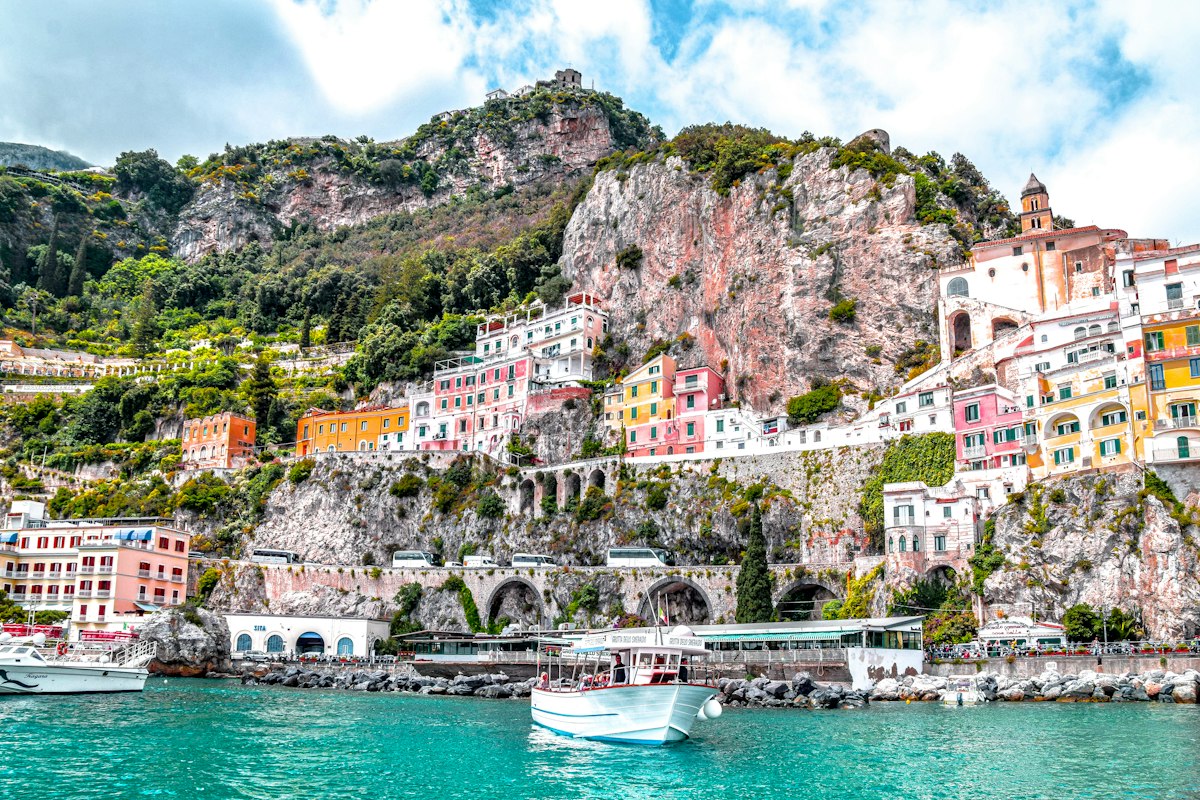
The Amalfi Coast suffers from a paradox familiar to the world's most photographed destinations: its beauty has become so widely reproduced that the image has begun to replace the experience, and visitors arrive with expectations so precisely formed by Instagram and travel supplements that the actual landscape — the vertiginous cliffs, the terraced lemon groves, the fishing villages compressed into narrow valleys — registers as confirmation rather than revelation. Positano has been reduced to a colour palette. Amalfi itself to a cathedral and a paper museum. The coast road has become a traffic jam disguised as a scenic drive.
Ravello exists above all of this — literally. Perched 365 metres above sea level on a ridge between the valleys of the Dragone and the Regina, accessible only by a winding road that climbs from the coast through a landscape of increasing verticality and diminishing crowd density, Ravello occupies a position in the Amalfi Coast hierarchy that is at once geographically peripheral and culturally central. It is the town you reach only when you decide to stop looking at the sea and start looking from above it. And from above it, everything changes.
Wagner's Garden: The Moment of Recognition
The story of Ravello's cultural ascent begins, as so many Italian luxury narratives do, with a visiting northern European who recognised in a southern landscape something his own civilisation could not produce. In May 1880, Richard Wagner visited the gardens of Villa Rufolo — the thirteenth-century palace built by the wealthy Rufolo family during Ravello's medieval golden age — and declared that he had found the garden of Klingsor, the enchanted domain he had been struggling to visualise for the second act of Parsifal, his final opera. "Klingsor's magic garden has been found," he wrote to his wife Cosima, and proceeded to compose portions of the score in a room overlooking the garden's layered terraces, exotic plantings, and infinite views of the Gulf of Salerno.
Wagner's endorsement — amplified by the cultural weight he carried in late nineteenth-century Europe — transformed Ravello from a forgotten hilltop town into a destination for the artistic and intellectual elite. Greta Garbo came. Virginia Woolf came. D.H. Lawrence wrote portions of Lady Chatterley's Lover here. Gore Vidal bought a villa (La Rondinaia, perched on a cliff edge above Amalfi) and lived in Ravello for decades, producing some of his sharpest political writing from a study that looked out over a view he described as the most beautiful in the world. The pattern was consistent: artists and writers of a certain sensibility arrived in Ravello, recognised that the town's elevation and isolation created conditions — silence, perspective, beauty without commercial intrusion — that were uniquely conducive to concentration, and stayed.
The Ravello Festival: Where Music Meets Altitude
The Ravello Festival, founded in 1953 in direct homage to Wagner's connection with the town, has evolved from a modest summer concert series into one of Italy's most distinguished music festivals — and, arguably, the most scenically spectacular classical music venue on earth. The festival's principal stage, the Belvedere of Villa Rufolo, is an open-air platform cantilevered above the cliff edge, where audiences sit in a garden setting facing a stage that has, as its backdrop, the entire panorama of the Amalfi coastline, the Gulf of Salerno, and, on clear evenings, the silhouette of Capri. Concerts begin at sunset. The light changes throughout the programme. The sea, 350 metres below, provides a basso continuo of its own.
The festival's artistic programming has, under successive directors, maintained a standard that justifies the venue's natural grandeur. The Berlin Philharmonic, the Vienna Philharmonic, the Orchestra dell'Accademia Nazionale di Santa Cecilia, and soloists of the calibre of Riccardo Muti, Valery Gergiev, and Lang Lang have performed on the Belvedere stage — drawn not only by the festival's growing reputation but by the rare experience of performing in a venue where the architecture is subordinate to the landscape and the landscape is subordinate to the music. For the audience, the experience is transformative in a way that indoor concert halls, however acoustically perfect, cannot replicate: the music is heard not in isolation from the world but in conversation with it.
Villa Cimbrone: The Terrace of Infinity
If Villa Rufolo anchors Ravello's Wagner narrative, Villa Cimbrone provides its visual climax. The Terrazza dell'Infinito — the Terrace of Infinity — at the southernmost point of Villa Cimbrone's gardens is a stone-balustraded promontory lined with eighteenth-century marble busts that projects into space above the coast. The view from the terrace encompasses a 180-degree panorama that extends, on clear days, from Punta Campanella and the Sorrento Peninsula in the west to Punta Licosa in the east, with the full sweep of the Gulf of Salerno and the distant mountains of Cilento visible between. Gore Vidal called it the most beautiful view in the world, and while such claims are by nature unprovable, it is difficult to identify a serious rival.
Villa Cimbrone itself — a composite creation assembled in the early twentieth century by the English lord Ernest William Beckett from medieval, Renaissance, and newly fabricated elements — is now a luxury hotel, its rooms and suites occupying spaces that range from a fourteenth-century cloister to a nineteenth-century library. The conversion has been executed with restraint that respects the villa's layered history while providing the amenities that contemporary luxury travellers require: a pool surrounded by rose gardens, a restaurant that serves cuisine rooted in Campanian tradition but elevated by contemporary technique, and a spa that draws on the Mediterranean herbal pharmacopoeia.
The Real Estate Paradox
Ravello's property market operates under constraints that are simultaneously frustrating for buyers and fundamentally protective of the town's character. The historic centre — a compact area of approximately 2,500 permanent residents — is designated as a protected heritage zone, which means that new construction is effectively impossible, exterior modifications to existing buildings require heritage approval that can take years to obtain, and the supply of available properties is determined entirely by the willingness of existing owners to sell.
Within these constraints, the market is small, opaque, and — when properties do become available — fiercely competitive. A restored palazzo apartment of 150-200 square metres, with views of the coast, currently trades between €1.5 million and €3 million. Standalone villas with gardens and direct views of the Gulf are rare enough that pricing is determined more by the vendor's attachment than by market comparables: recent transactions have ranged from €4 million for relatively modest properties to figures that are not publicly disclosed but are understood, within the local real estate community, to exceed €15 million.
The rental market provides more liquid access to Ravello's elevated luxury. A four-bedroom villa with a private pool and Gulf views commands €3,000-€8,000 per night during the summer festival season (June through September), with premium properties booked twelve months or more in advance by a returning clientele of primarily American, British, and northern European visitors for whom Ravello represents not a holiday destination but a recurring ritual of aesthetic and sensory recalibration.
The Gastronomy of Altitude
Ravello's culinary scene benefits from the same altitude that defines its visual character. The town sits at the upper limit of the Amalfi Coast's lemon-growing zone — the Sfusato Amalfitano, the elongated lemon variety that produces the region's limoncello and that flavours everything from risotto to delizia al limone — and at the lower limit of the chestnut and walnut forests of the Lattari Mountains. This transitional position creates a micro-larder of unusual diversity: citrus and seafood from below, nuts and mushrooms and wild herbs from above, and the dairy products of a pastoral tradition (fiordilatte, provola affumicata, ricotta di pecora) that extends from the mountain pastures behind the town to the village creameries where cheese is still made by hand.
The Michelin-starred Palazzo Avino — housed in a twelfth-century palace that was converted to a luxury hotel in the 1990s — and the more recently recognised Rossellinis provide destination dining at a level that draws visitors specifically for the culinary experience. But Ravello's greatest gastronomic achievement may be the quality of its simpler establishments: the family-run trattorie in the streets behind the Duomo, where pranzo del giorno consists of handmade scialatielli with Cetara anchovies, followed by grilled orata with Ravello lemons, served on a terrace overlooking the Dragon Valley for a total expenditure of €35 per person. This is not cheap food; it is food of extraordinary quality at prices that reflect a local economy still partially insulated from the cost structures of international luxury tourism.
The Silence Premium
Ravello's ultimate luxury — the asset that undergirds all other values and that no amount of money can manufacture — is silence. The town's elevation places it above the traffic noise that makes the Amalfi Coast road a daytime assault on the senses. Its pedestrian-only historic centre eliminates the motorcycles, Vespas, and delivery vehicles that provide the acoustic baseline of Italian coastal towns. And its resident population — small, ageing, and increasingly supplemented by a non-permanent community of villa owners and long-stay visitors — generates the kind of low-density soundscape in which individual sounds (church bells, birdsong, the distant murmur of a garden fountain) are audible as distinct events rather than being submerged in ambient noise.
For the luxury buyer or renter who has experienced the world's most expensive hotels and private residences, this silence is not merely pleasant; it is revelatory. It is the condition that makes the Ravello Festival's open-air concerts possible (there is no competing noise to amplify over). It is the reason that writers from Wagner to Vidal to contemporary authors who prefer not to be named chose Ravello as a working location. And it is the quality that, in an increasingly noisy world, gives Ravello a premium that no amount of beachfront development on the coast below can replicate.
Three hundred and sixty-five metres above the Amalfi Coast, where Wagner found his enchanted garden and Gore Vidal found the world's most beautiful view, Ravello continues to offer what no algorithm can optimise and no development can construct — the luxury of looking down upon beauty in silence.