Cinque Terre: How Liguria's Five Cliffside Villages Became Italy's Most Chromatically Intense Luxury Address
March 27, 2026 · 14 min read
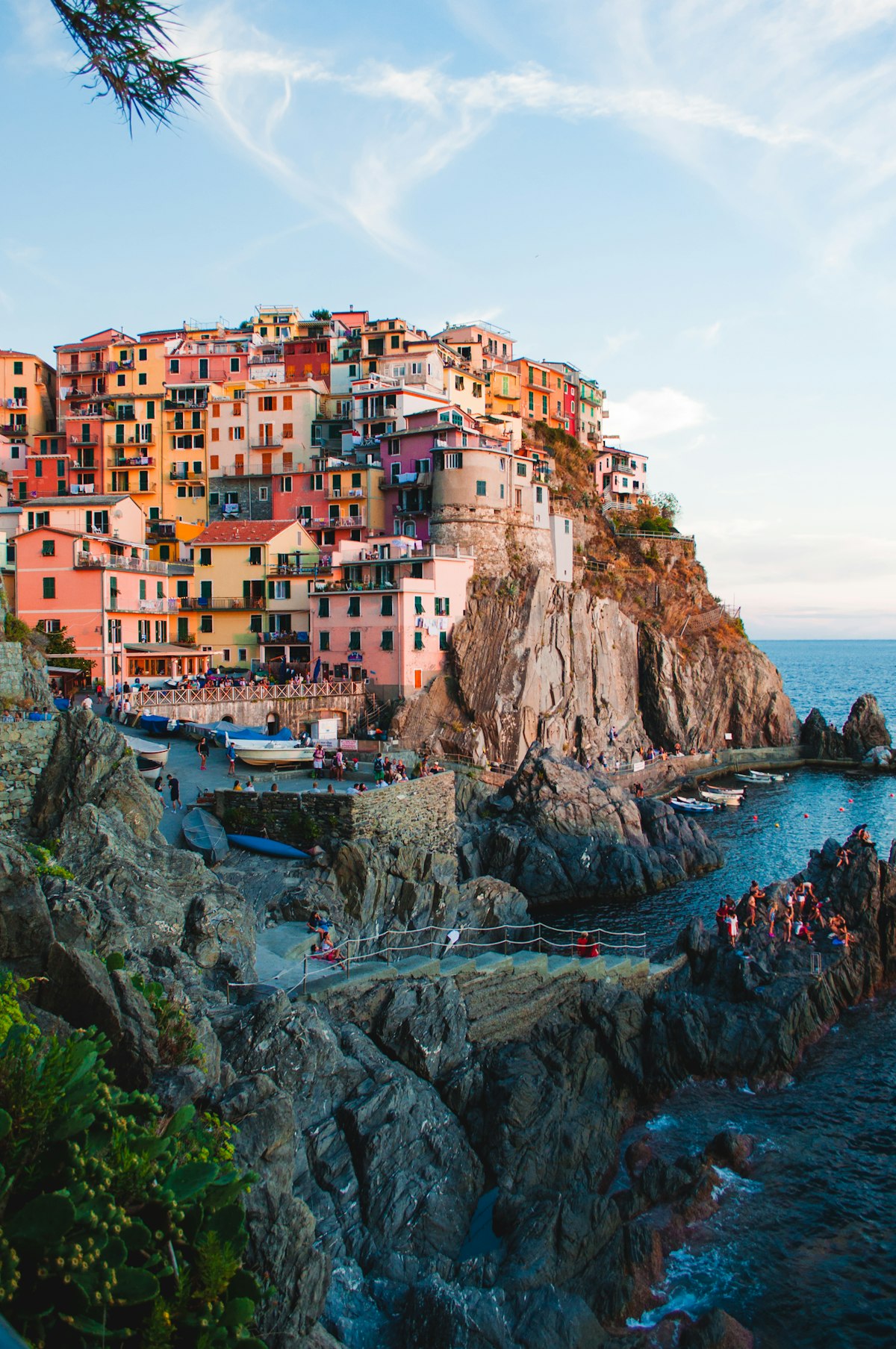
The colours arrive before the understanding. Rounding a bend on the coastal path from Corniglia to Vernazza, the fourth of the five villages appears below you — a cascade of houses in ochre, terracotta, salmon pink, and saffron yellow, tumbling down a steep ravine to a harbour so small that the fishing boats seem to lie in the village's lap rather than at its feet. Behind and above, the terraced hillsides — six thousand kilometres of dry-stone walls, built by hand over a millennium, creating a vertical agricultural landscape that UNESCO has compared in ambition and engineering to the rice terraces of the Philippines — climb toward a skyline of dark Mediterranean macchia. Below, the Ligurian Sea achieves a blue of such concentrated intensity that the word "blue" feels inadequate, as if the language itself had not anticipated this particular chromatic proposition. This is the Cinque Terre: five villages, eighteen kilometres of cliffside, and one of the most visually overwhelming landscapes in Europe.
Five Villages, Five Characters
Monterosso al Mare, the northernmost and largest of the five, is the only village with a proper beach — a stretch of sand divided by a medieval tower into the old town (the Fegina side) and the historic centre, where the fourteenth-century church of San Giovanni Battista anchors a cluster of narrow streets that wind between the typical Ligurian tower-houses, their upper floors originally designed to provide defensive height against Saracen raiders. Monterosso is the most accessible and the most conventionally resort-like of the five, with hotels, trattorias, and beach establishments that cater to the visitor who wants Cinque Terre beauty without Cinque Terre asceticism.
Vernazza is the jewel — the village that appears on every poster, every guidebook cover, every Instagram feed that features the Italian coast. Its harbour, formed by a natural inlet protected by a promontory on which the ruins of the eleventh-century Doria Castle still stand, creates a composition of such photogenic perfection that the mind suspects staging. The Piazza Marconi, the village's tiny main square opening directly onto the harbour, is the social heart of the Cinque Terre — the place where fishermen mend nets at dawn, children play football in the afternoon, and visitors gather at dusk to watch the sunset paint the façades in colours that no photograph can reproduce because no camera has been built that can capture the full emotional spectrum of Mediterranean light at the golden hour.
Corniglia, the middle village and the only one with no direct sea access, sits on a promontory approximately a hundred metres above the water, reached from the railway station by the Lardarina — a brick staircase of 382 steps that serves as both transport infrastructure and cardiovascular test. Corniglia's elevation gives it a character distinct from its neighbours: quieter, more agricultural, surrounded by vineyards rather than water, with views along the coast in both directions that encompass the full sweep of the Cinque Terre landscape. It is the village that the connoisseur prefers.
Manarola, considered by many the most beautiful of the five (though this judgement changes with the light and the season), is built on a dark rock formation that gives its coloured houses — particularly the famous row of buildings that faces south, catching the afternoon light — an intensity against their geological background that approaches the psychedelic. The village's tiny harbour, where fishing boats are hoisted onto the rock by winch, and the swimming platform carved from the living stone at the promontory's tip, provide the most dramatic point of encounter between architecture and sea in the entire Cinque Terre.
Riomaggiore, the southernmost village and the gateway for visitors arriving from La Spezia, is the most vertically dramatic — its houses stacked up a steep valley in a formation that suggests not so much a settlement as a geological event, as if the buildings had grown from the rock rather than been placed upon it. The via dell'Amore (the Path of Love), which once connected Riomaggiore to Manarola via a dramatic cliffside walkway, has been closed for repairs since 2012 — a closure that, while disappointing for visitors, has paradoxically enhanced Riomaggiore's character by removing it from the most-trodden tourist circuit and preserving something of the isolation that defined all five villages before the tourist era.
The Terraces: A Thousand Years of Vertical Agriculture
The terraced hillsides of the Cinque Terre represent one of the most extraordinary examples of human landscape modification in the Mediterranean. Over approximately a thousand years — from the early medieval period onward — the inhabitants of the five villages constructed an estimated 6,729 kilometres of dry-stone retaining walls, creating narrow terraces on gradients of up to 45 degrees on which they planted vineyards, olive groves, and lemon trees. The scale of this achievement — often compared to the Great Wall of China in cumulative length, though the comparison flatters neither — is difficult to comprehend until you stand on the coastal path and see the terraces rising above you to the ridgeline, each wall hand-built from local stone without mortar, each terrace a few metres wide, the entire composition extending for kilometres along the coast.
The wine produced on these terraces — predominantly Bosco, Albarola, and Vermentino grapes, unified as the DOC Cinque Terre Bianco — is light, mineral, and saline, reflecting the maritime microclimate in which it is grown. The rarest expression is Sciacchetrà, a passito (dried-grape) dessert wine of extraordinary complexity: golden, honeyed, with notes of dried apricot and Mediterranean herbs, produced in tiny quantities from grapes dried on racks exposed to the sea wind. Sciacchetrà has been made in the Cinque Terre since at least the fourteenth century and was described by Boccaccio in terms that suggest a wine already old and revered in his time. A bottle from a good producer — Walter De Battè, Buranco, Possa — represents one of the rarest and most historically significant wines in Italy.
The Ligurian Table: Simplicity as Sophistication
The cuisine of the Cinque Terre is Ligurian cuisine at its most elemental: anchovy, olive oil, basil, pine nuts, and the produce of terraces too steep and too small for anything but the most careful cultivation. Pesto alla genovese — the basil sauce that is Liguria's gift to world gastronomy — achieves its finest expression here, where the basil (grown in the salt-aired microclimate of the coastal terraces) has a sweetness and intensity that the commercially cultivated product cannot approach. Trofie al pesto (hand-twisted pasta with pesto, green beans, and potato), focaccia di Recco (a paper-thin flatbread filled with stracchino cheese), and acciughe di Monterosso (fresh anchovies, salt-cured in the local tradition) constitute a culinary repertoire of modest ambition and extraordinary flavour.
The restaurants of the Cinque Terre are, with a few exceptions, small, family-run establishments where the menu follows the catch and the season rather than the expectations of the tourist market. The finest — Cappun Magru in Manarola, Miky in Monterosso, La Torre in Vernazza — achieve a quality of cooking that derives not from technique or presentation but from the sheer excellence of ingredients grown, caught, and prepared within a radius of a few kilometres.
The Sentieri: Walking as Luxury
The trail network that connects the five villages — and extends into the surrounding Parco Nazionale delle Cinque Terre — constitutes one of the great walking experiences in Europe. The Sentiero Azzurro (the Blue Path, trail number 592), which links Riomaggiore to Monterosso via the four intermediate villages, covers approximately twelve kilometres and can be walked in five to seven hours, though the wise traveller allows a full day, with extended stops for swimming, eating, and the contemplative absorption of views that change character with every hundred metres of progress along the coast.
The higher trails — particularly the Sentiero Rosso (the Red Path, trail number 1), which follows the ridgeline above the villages at an altitude of approximately 600 metres — offer a completely different perspective: instead of looking up at the terraces from sea level, you look down upon the entire Cinque Terre landscape, with the five villages reduced to colourful clusters at the foot of the cliffs and the Ligurian Sea extending to a horizon that, on clear days, includes Corsica. The walking here is more demanding but the solitude is nearly complete, even in high season.
Getting There & Practical Intelligence
The Cinque Terre are best accessed by train: the regional line connecting La Spezia to Genova Sestri Levante stops at all five villages, with trains running approximately every fifteen to thirty minutes. La Spezia itself is connected to the national rail network, with direct services from Rome (three hours), Florence (two and a half hours), and Milan (three hours). Pisa airport is approximately ninety minutes by car; Genova airport approximately two hours. Cars are essentially useless within the Cinque Terre — parking is extremely limited and the villages are pedestrian — though a car is convenient for reaching La Spezia or the surrounding area.
The Cinque Terre Card, available for one or two days, provides unlimited train travel between the five villages and La Spezia, plus access to the Sentiero Azzurro and the park's other facilities. The optimal seasons are April-May and September-October, when the weather is warm, the trails are open, and the visitor numbers are manageable. July and August bring crowds that fundamentally alter the character of the villages, particularly Vernazza and Riomaggiore; the luxury traveller is advised to visit in the shoulder seasons or, better still, in winter, when the villages return to their inhabitants and the landscape achieves a dramatic severity — grey sea, bare vines, low clouds on the ridgeline — that reveals qualities invisible in the summer brilliance.
Published by Italy Latitudes · Part of the Latitudes Media network